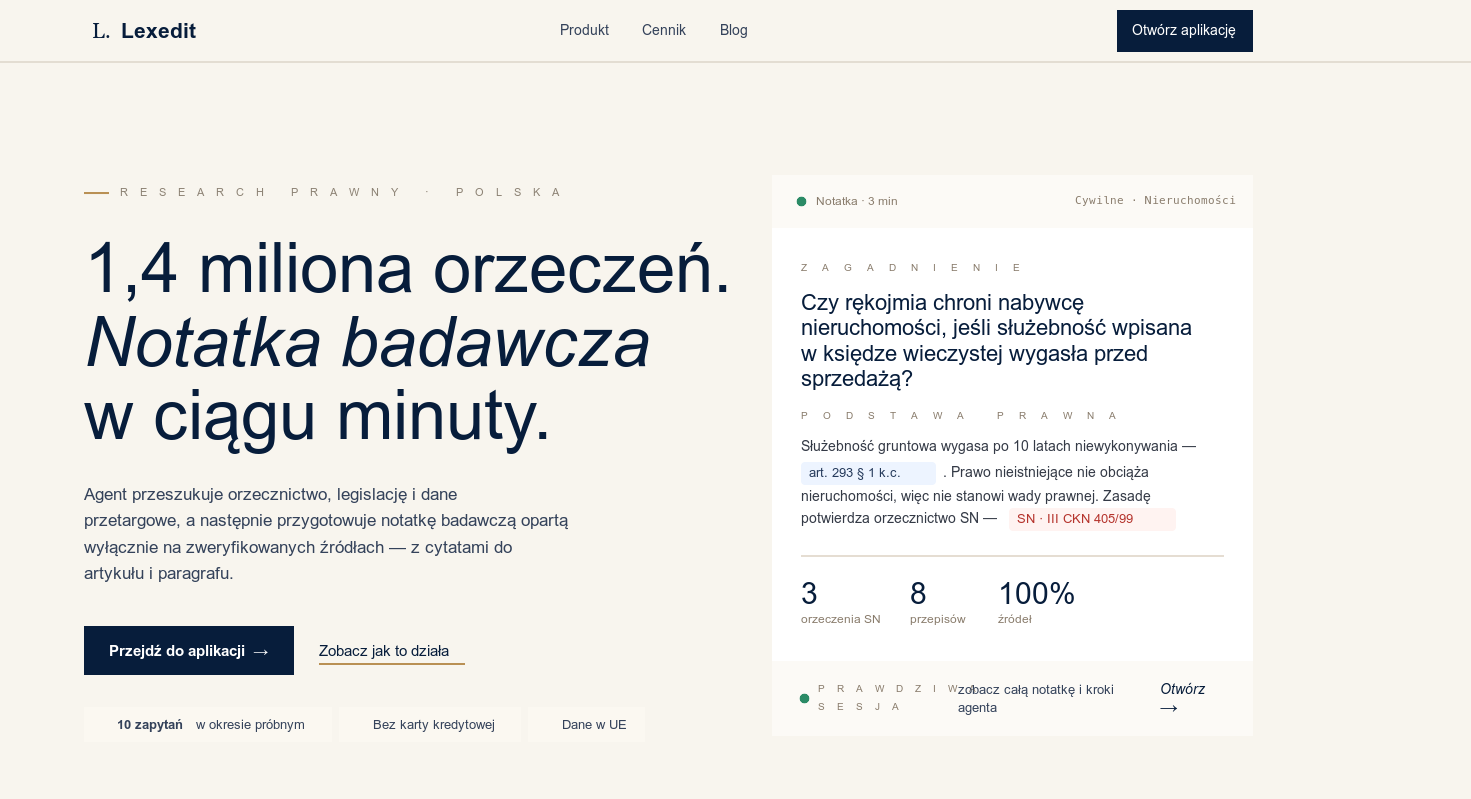
Industry: Legal tech
Use case: Source-backed legal research, case law and legislation analysis, legal document drafting, and cross-device research continuity
What we built: AI research agent; Polish case law and ISAP legislation search; citation verification; document artifacts and versioning; follow-up workflows; mobile research app
Live at: lexedit.ai
From Document Assistant to Legal Research Workspace
The first version of Lexedit focused on legal document work: reviewing contracts, applying playbooks, and helping lawyers draft changes. That foundation is still there, but the product has grown into something broader and more useful for day-to-day legal work: an AI research workspace for Polish lawyers.
The core question changed from "can AI edit this document?" to "can AI help a lawyer move from a legal question to a verified memo and then to a usable draft without losing the source trail?" For legal professionals, plausibility is not enough. Every conclusion needs a statute, a case reference, a quoted passage, or a clear statement that the system could not verify the point.
Lexedit now searches Polish case law, legislation, and selected public data, prepares research memos with clickable citations, helps continue the analysis through follow-up questions, and can turn the work into a draft document in the same thread. The goal is not a chatbot. The goal is a legal workbench that keeps source-backed reasoning close to the document being produced.
Core Product Capabilities
Verified Legal Research Memos
Lawyers ask Lexedit a legal question in natural language. The agent classifies the task, builds a research plan, searches across more than 1.4 million court rulings and over 100,000 legal acts from ISAP, reads the relevant materials, and then writes a structured memo.
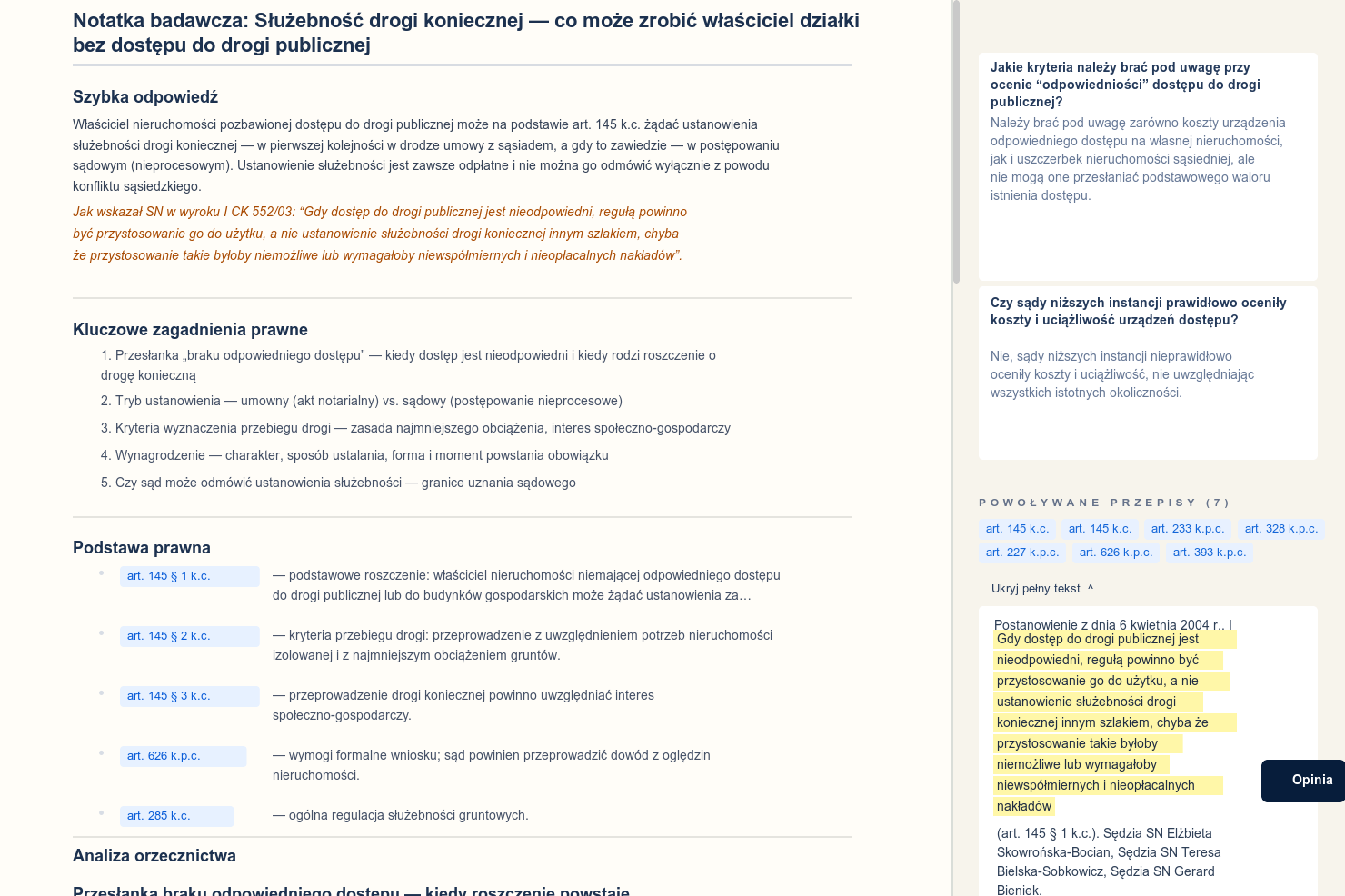
The important part is the evidence model. Citations are not decorative footnotes. Each case reference, article, and quoted passage can be opened and inspected. The interface shows the memo on one side and the underlying ruling or provision on the other, with the relevant excerpt highlighted.
Law as of a Specific Date
Legal research often depends on time. The applicable version of a statute may be different on the date of the dispute than it is today. Lexedit supports temporal statute lookup so the agent can reason over the wording that applied at the relevant moment, not just the latest consolidated text.
Documents Beside the Analysis
Research does not usually end with a memo. A lawyer may need a demand letter, a pleading, a contract clause, a client note, or a list of evidentiary gaps. Lexedit can create a document artifact from the same thread that produced the analysis, preserving the context and source trail.
Generated documents open in a working panel next to the memo. Users can manually edit the text, ask the agent to revise the active document, restore previous versions, and export to DOCX. This turns the research thread into a practical drafting loop: ask, verify, draft, revise, export.
Follow-Ups That Understand the Thread
After a completed answer, Lexedit can suggest concrete next steps based on the memo, citations, unresolved factual gaps, or the active document. A follow-up might ask the agent to compare two lines of case law, verify a specific citation, add a missing argument, or adapt the result into a document.
These suggestions keep users in the flow of the case. Instead of starting over with a new prompt, the lawyer continues the same matter, with the previous findings, uploaded documents, and generated artifacts still available as context.
Mobile Research Continuity
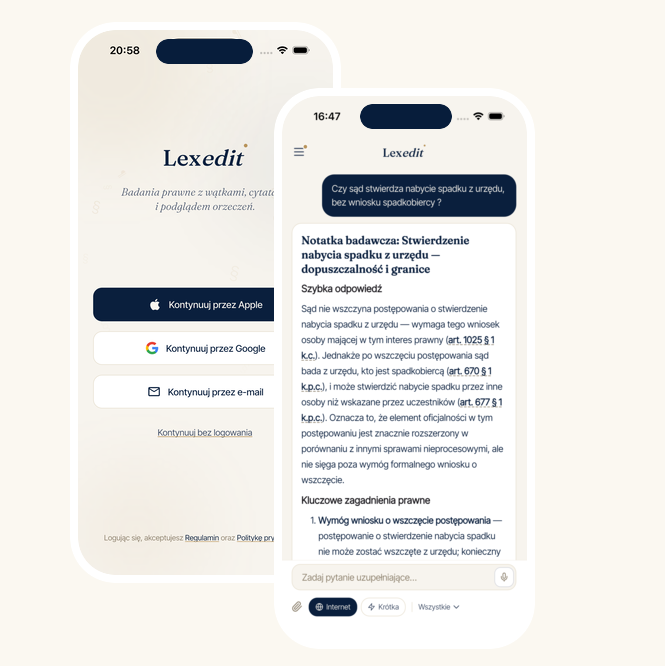
Lexedit also includes a mobile research experience for iOS and Android. The mobile app shows agent progress, supports follow-up questions, keeps citations visible in the answer, and lets users open generated documents from the thread.
The mobile flow is especially useful for review and continuation. A lawyer can start a larger research task on desktop, then read the result, check progress, or add a follow-up from a phone.
Architecture Highlights
- Source-first agent design - the research flow plans the legal question, searches verified databases, reads source material, and only then writes the memo.
- Citation registry - citations and excerpts are kept as structured data so the UI can open the exact ruling or statute behind the answer.
- Case law and legislation pipelines - Lexedit indexes Polish rulings and ISAP legislation, including historical statute versions for date-sensitive research.
- Durable long-running jobs - research runs persist progress events, status, leases, retries, and cancellation state so the frontend can reconnect without losing the matter.
- Document artifact model - generated documents are stored with version history, editable markdown, restoration, and DOCX export.
- Multi-surface product - the same research thread model powers the web app, shared reports, mobile app, and user education flows.
What This Changed for Users
- Less manual source hunting: the agent searches broadly, then shows the actual materials behind the memo.
- Better trust: conclusions stay attached to statutes, case references, and highlighted excerpts.
- Fewer context switches: research, follow-up questions, generated documents, versions, and DOCX export live in one workspace.
- More practical outputs: a research answer can become a working draft instead of a dead-end chat transcript.
- Continuity across devices: mobile support makes it easier to resume, review, and continue work away from the desk.
Product Lessons
The hardest part of legal AI is not generating fluent text. It is preserving provenance. Lawyers need to know where a statement came from, whether a cited case exists, whether a statute version applies to the facts, and what remains uncertain.
Lexedit is built around that constraint. The interface makes verification a first-class interaction. The backend treats research as a durable job, not a single request. The document system keeps drafting connected to the analysis instead of splitting work across five tools.
Want to Build Something Similar?
Lexedit shows what happens when AI product development starts from the real workflow: source-backed research, drafting, review, mobile continuity, and the small product details that make professionals trust the system enough to use it.
Try Lexedit at lexedit.ai. If you are building AI for legal, healthcare, finance, public-sector, or any domain where evidence and confidentiality matter, TUUL can help design the workflow, model orchestration, and product surface around those constraints.
Contact TUUL: hello@tuul.ai