Industry: Legal tech
Use case: AI-assisted contract review, document editing, anonymization, and generation
What we built: Web workspace • AI contract review • Client-side anonymization • Document generation • Knowledge transfer playbooks • Chrome extension
Live at: lexedit.ai
Why Lexedit
Lawyers spend a staggering amount of time on repetitive document work — reviewing contracts clause by clause, manually redacting personal data, recreating similar documents from scratch, and trying to maintain consistent standards across a team. The tools they use are fragmented: Word for editing, email for sharing, generic AI chatbots that can't be trusted with confidential client data.
Lexedit brings all of that into a single, privacy-first workspace. Upload a contract, get an instant risk analysis. Edit documents with natural language instructions. Anonymize sensitive data without it ever leaving the browser. Generate new legal documents from existing workspace context. Transfer a senior lawyer's editing standards to every future document automatically.
Privacy by design. Intelligence where it counts. Try it at lexedit.ai.
Core Features
AI Contract Review & Playbook Application
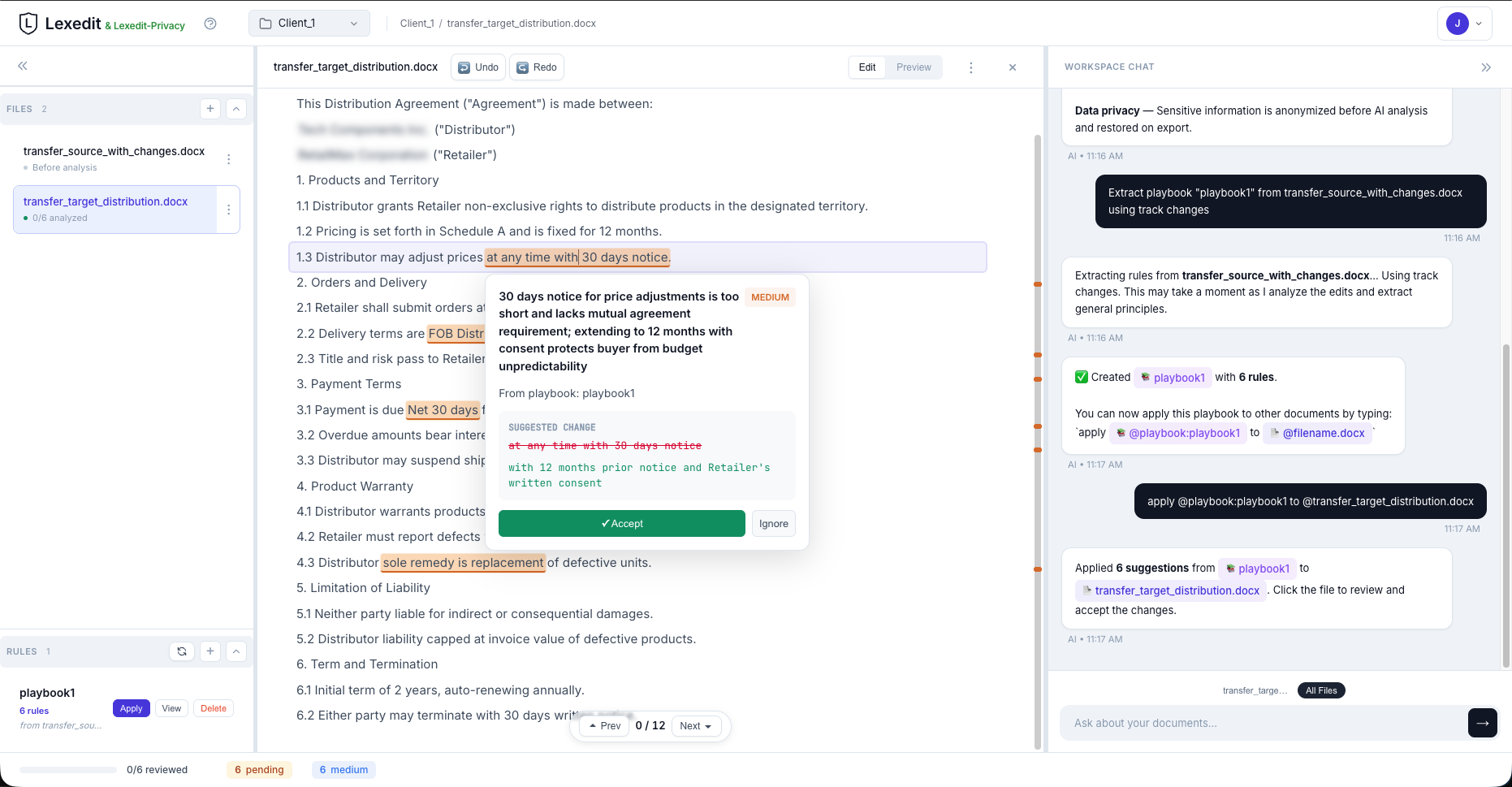
Upload a contract and Lexedit's AI reviews every clause, classifying them by risk level. Click any highlighted clause to see a plain-language explanation, risk assessment, and a concrete suggested change — with one-click Accept or Ignore. The workspace chat drives the entire workflow: extract a playbook from one document, then apply it to another with a single command like apply @playbook:playbook1 to @target.docx.
Privacy-First Anonymization
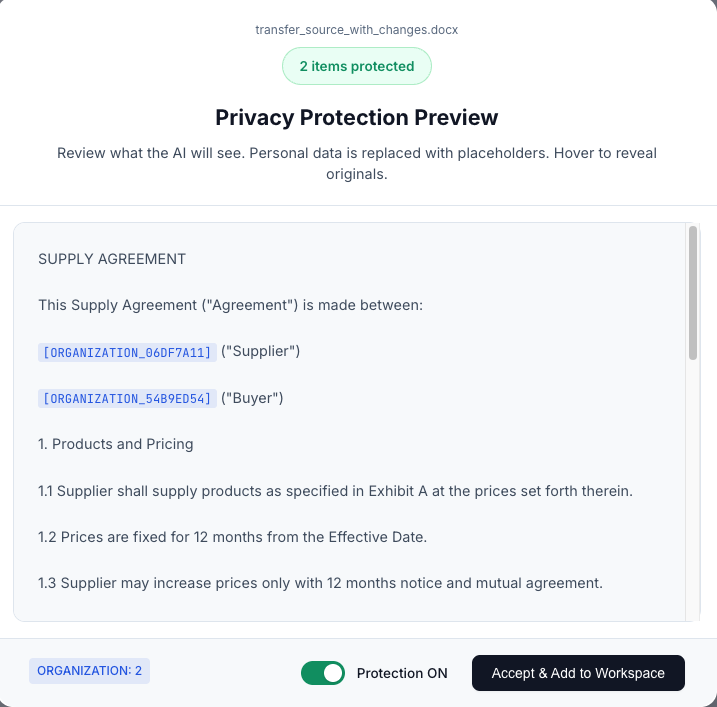
When a document is uploaded, a BERT-based Named Entity Recognition model — running entirely in the browser — detects and replaces personally identifiable information with anonymized placeholders like [ORGANIZATION_06DF7A11]. Organization names, personal names, addresses, dates — all redacted before any data leaves the user's device. A Privacy Protection Preview shows exactly what the AI will see, with a "Protection ON" toggle giving users full control.
The anonymization is fully reversible: hover over a placeholder to reveal the original value, or de-anonymize the entire document on export. The system supports Polish, German, and English, with the NER model specifically trained on legal documents.
AI-Assisted Editing
Instead of manually hunting through clauses, lawyers describe what they want changed in plain language — "Change the payment term from 30 to 14 days" or "Add a non-compete clause for 12 months." Lexedit shows the proposed changes as a visual diff: red strikethrough for deletions, green underline for insertions. Accept individual changes or apply them in bulk. Every edit is tracked with full author attribution, compatible with Microsoft Word's track changes.
Document Generation
Need a demand letter based on an existing contract? A lawsuit referencing multiple source documents? Lexedit generates new legal documents from workspace context. The AI extracts party information, dates, amounts, and relevant clauses from uploaded documents and weaves them into a properly structured new document. Missing information is clearly marked with [FILL] placeholders so nothing slips through.
Knowledge Transfer & Playbooks
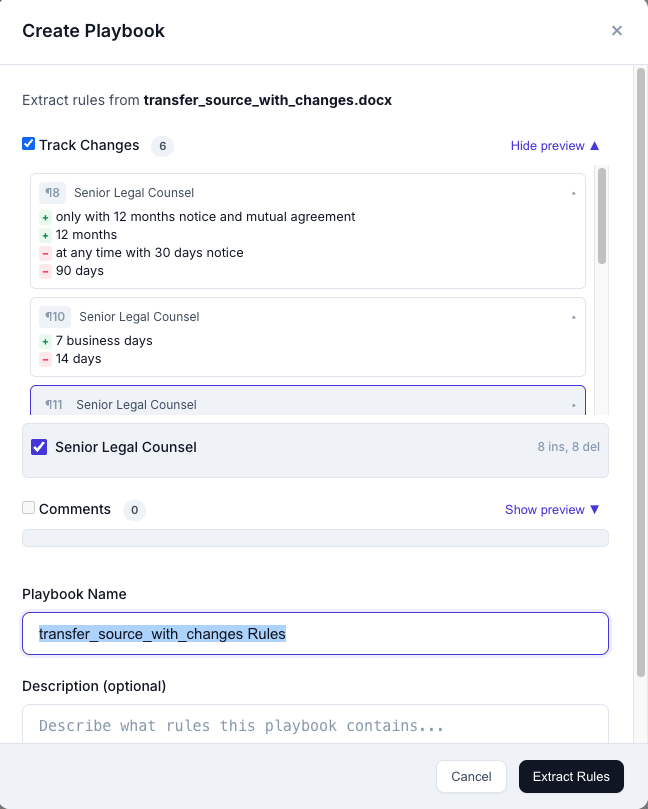
When a senior lawyer reviews a template contract and leaves track changes, those edits encode years of legal expertise. Lexedit extracts those editing patterns into a reusable playbook — filter by author, preview the diffs, name the playbook, and save. For example, a Senior Legal Counsel's changes like "extend notice period from 30 days to 12 months with mutual agreement" become codified rules that can be applied to any new contract in one click.
Architecture Highlights
- Client-side anonymization — BERT NER model runs in the browser via Transformers.js. Sensitive data never reaches the server.
- Multi-model LLM backend — Users can choose between Claude, Gemini, Grok, and other models depending on speed, cost, and quality needs.
- Extended thinking — Contract reviews use Claude's reasoning mode for deeper, more thorough legal analysis.
- Streaming responses — All AI operations stream results in real-time so lawyers see progress immediately.
- Track changes compatibility — Full interoperability with Microsoft Word's revision tracking.
- Multi-language support — UI and NER models support Polish, German, and English.
Chrome Extension
For quick anonymization without logging into the full workspace, Lexedit ships as a Chrome extension. Paste or upload a document, get instant PII redaction powered by the same BERT model — all running locally in the browser. Useful for quick checks before sharing documents via email or other platforms.
Results & Impact
- Review speed: AI identifies and classifies risky clauses in seconds, not hours.
- Privacy assurance: 100% client-side anonymization means zero server-side exposure of PII.
- Consistency: Playbooks encode legal standards once, apply them everywhere.
- Knowledge multiplication: Senior expertise scales across the entire team through reusable rules.
- Unified workflow: Review, edit, generate, anonymize — all in one place instead of five disconnected tools.
Want to Build Something Similar?
Lexedit shows what's possible when you combine LLMs with domain-specific workflows and a privacy-first architecture. Try it at lexedit.ai. Whether you're in legal, healthcare, finance, or any field that handles sensitive documents — the same patterns apply.
Contact TUUL: hello@tuul.ai